
So your house has been sitting on the market for over two months. The showings have slowed to a trickle, your agent is suggesting another price drop, and you’re wondering if there’s a better option than just bleeding money while you wait.
Here’s something worth considering: home staging. Yes, it costs money upfront. But if it gets your home sold faster and potentially for more money, that initial investment starts looking pretty smart, especially when you calculate what each additional month on the market is actually costing you.
Let’s break down what home staging actually costs in 2026, and more importantly, whether it makes financial sense when your property is already struggling to sell.
What Home Staging Actually Costs in Charlotte
The honest answer? It depends on several factors, the size of your home, whether it’s vacant or occupied, and what level of staging you need.
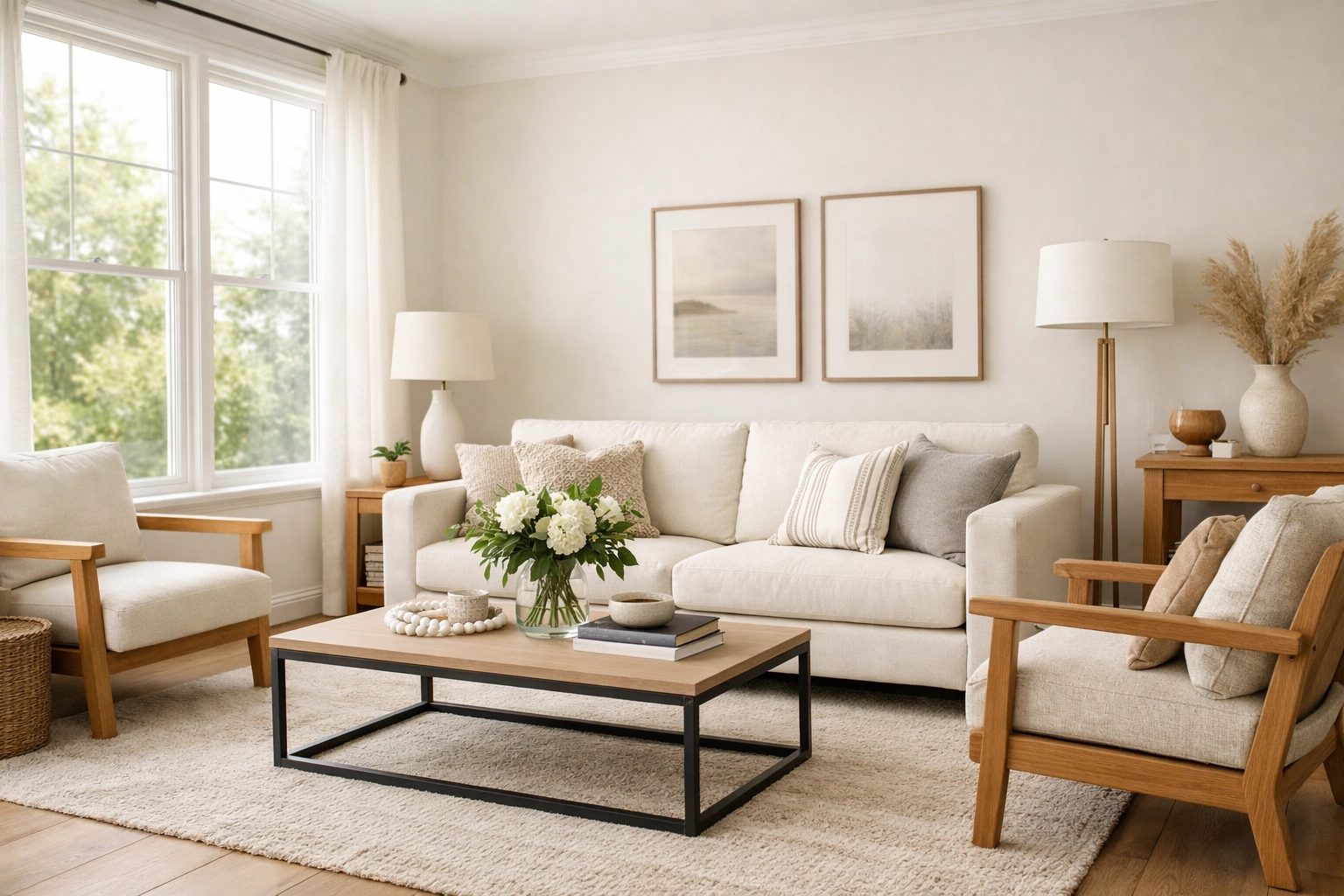
Based on current market data, here’s what you’re looking at:
Initial Consultation: $150 to $600 for a two-hour walk-through where a professional stager assesses your home and creates a staging plan. Some companies roll this into their staging fee if you move forward with full services.
Occupied Home Staging: Around $800 for a flat fee if you’re working with your existing furniture. This typically includes decluttering guidance, furniture rearrangement, and strategic styling to make your space more appealing to buyers.
Vacant Home Staging: Starting at $2,200 and going up depending on the square footage and number of rooms. Vacant homes need furniture rental, which is why the cost jumps significantly.
Per-Room Pricing: $300 to $700 per room if you only want to stage key spaces like the living room, master bedroom, and kitchen.
Monthly Rental Fees: If you’re staging a vacant home, expect $500 to $600 per month per staged room, usually with a three-month minimum contract.
Percentage-Based: Some stagers charge 0.5% to 2% of your home’s list price. For a $400,000 home, that’s $2,000 to $8,000.
The national average hovers around $1,800, but Charlotte’s market can vary depending on your specific neighborhood and the stager’s experience level.
The Math When Your Home Won’t Sell
Here’s where things get interesting. Let’s say your home is listed at $400,000 and has been sitting for 60+ days. What’s that costing you?
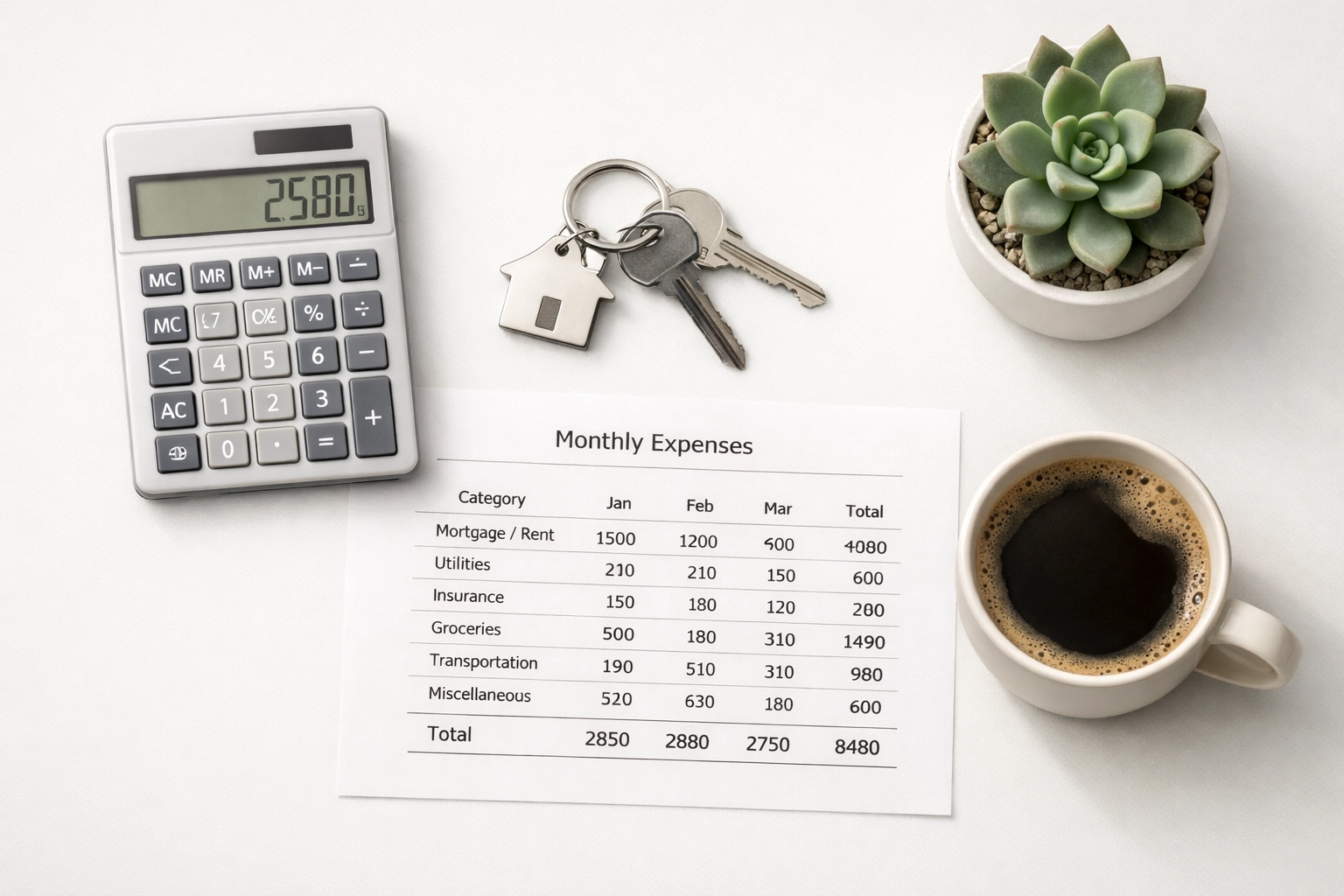
Monthly carrying costs add up fast:
- Mortgage payment (assuming $2,200/month on a $320,000 loan)
- Property taxes ($300/month on average)
- Insurance ($150/month)
- Utilities if vacant ($200/month)
- HOA fees if applicable ($100-300/month)
That’s roughly $2,850 to $3,150 per month you’re spending while the house sits empty. Over 60 days, you’ve already lost $5,700 to $6,300 just in carrying costs. And that’s before we talk about the opportunity cost of not having that equity available for your next move.
Now add in the reality that homes sitting on the market for extended periods often end up selling for less than fresh listings. Buyers assume something’s wrong. They lowball. The longer it sits, the more desperate you look.
Suddenly, that $800 to $2,200 staging investment doesn’t sound so bad, does it?
What Staged Homes Actually Do Differently
The data is pretty compelling: staged homes spend 90% less time on the market than non-staged homes. That’s not a small difference, that’s the difference between a 90-day listing and a 9-day listing in some cases.
But why? What’s actually happening when buyers walk through a staged home versus an unstaged one?
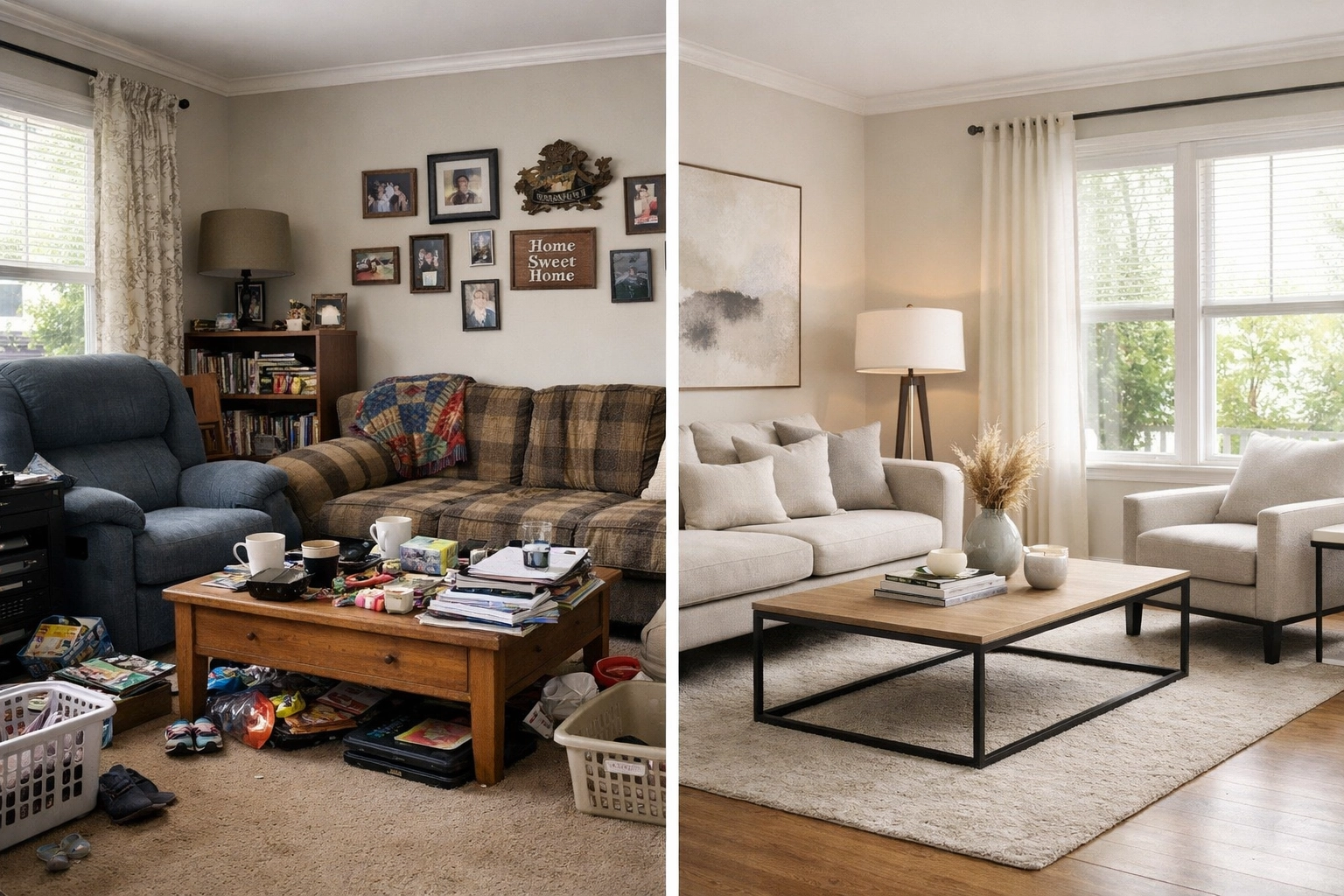
They can picture themselves there. Empty rooms feel smaller and weird. Cluttered rooms feel overwhelming. Properly staged rooms feel like home, just not your home. That’s the magic. Buyers can project their life into the space without having to mentally edit out your family photos, collections, or questionable furniture choices.
The home photographs better. In 2026, your online photos are everything. Most buyers decide whether to even schedule a showing based on those listing photos. Staged homes photograph like magazine spreads. Unstaged homes photograph like… well, someone’s actual house.
Flaws become less obvious. A good stager knows how to draw the eye to your home’s best features and away from its limitations. That awkward layout? Fixed with strategic furniture placement. Those outdated light fixtures? Less noticeable when the room is styled beautifully.
When Staging Makes the Most Sense
Not every home needs full staging, and not every situation calls for the same approach. Here’s when staging becomes especially worth it:
Your home is vacant. Empty homes are notoriously hard to sell. Rooms look smaller, sounds echo weird, and buyers struggle to visualize the space. If your home is sitting empty past 30 days, staging should be a serious consideration.
You’re in a competitive market. If there are multiple similar homes for sale in your neighborhood, staging gives you a tangible edge. When buyers are comparison shopping, the staged home almost always wins the showing.
Your home has been sitting 60+ days. This is you right now. At this point, something needs to change. You can drop the price again, or you can invest in staging that might help you maintain your asking price while attracting fresh interest.
You’ve already made repairs but still no offers. If you’ve addressed inspection issues, updated what needed updating, and your home is still languishing, the problem likely isn’t the house itself: it’s the presentation.
Your furniture is… not helping. This is hard to hear, but if your furniture is outdated, oversized for the space, or creating a cluttered look, it’s actively working against your sale. Sometimes the best staging advice is “less is more,” and sometimes it’s “let’s bring in different furniture entirely.”
Different Options for Different Budgets
If full staging feels out of reach, there are middle-ground options:
Consultation only ($150-600): A stager walks through, gives you detailed feedback on what to change, and you do the work yourself. This works if you’re willing to rent a storage unit, rearrange furniture, and style based on professional guidance.
Partial staging ($1,000-1,500): Stage only the key rooms: usually living room, master bedroom, and kitchen. These are the spaces that matter most to buyers and where staging has the biggest impact.
Hybrid approach ($800-1,200): Use your existing furniture where it works, supplement with rental pieces where it doesn’t, and bring in a stager for the styling and arrangement.
What You Should Actually Expect
Here’s the thing staging won’t do: it won’t magically sell an overpriced home. If your house is listed 20% above comparable sales, staging isn’t going to fix that. The market is what it is.
But if your pricing is reasonable and your home is just struggling to stand out or show well, staging can absolutely be the difference-maker. Especially in Charlotte’s market where inventory levels and buyer expectations are constantly shifting.
The best-case scenario? You invest $1,500 in staging, your home sells within two weeks at asking price, and you avoid another month or two of carrying costs plus the likely price reduction you were facing anyway. You’re ahead financially, and you’re done with the stress of a stale listing.
The worst-case scenario? You spend $1,500 on staging and your home still takes another month to sell. But it photographs better, shows better, and you potentially avoid a steeper price cut. You’re probably still coming out ahead.
Making the Decision
If your home has been sitting 60+ days, you’re at a decision point anyway. You can:
- Drop the price (again)
- Wait it out and hope
- Try staging
The price drop is guaranteed money off your net proceeds. Waiting costs you monthly carrying costs with no guarantee of results. Staging is an investment that statistically improves your odds significantly.
For most sellers in your situation, staging is the move that makes the most financial sense. It’s not about making your home prettier: it’s about solving the problem that’s keeping it from selling.
Want to explore what staging could do for your specific property? Creative Home Stagers offers consultations that can give you a clear picture of costs and expected results for your Charlotte home. Sometimes the best way to stop losing money is to spend a little strategically.